The restaurant offers a pan-Asian reflection of travels that “helped enlighten and excite and inspire” owner Billy Dec.
ONE RAINY DAY in Singapore, Billy Dec ducked into a museum of Asian civilizations. A Filipino American entrepreneur, he had been searching for the perfect name for his first Asian restaurant. He wanted something “inclusive of all” but not “stereotypical.”
While he waited out the weather, he took the opportunity to speak with a docent. The docent showed Dec a simulation of melting glaciers and suggested the name Sunda. Sundaland, an ancient land mass, was fragmented by a post-glacial rise in sea level over 11,000 years ago.
“Water levels rise, it sinks part of Southeast Asia, creating all these waterways and trade and unique islands,” Dec says.
The name seemed fitting for the Asian restaurant he was looking to open, which highlights flavors and cuisines from throughout the region. He sought out a Sunda historian to obtain a certificate (Dec’s own measure of authenticity) before opening in Chicago in 2009.
A Sunda restaurant in Nashville, then Tampa and another in the Windy City followed. Now, Michiganders have a Sunda New Asian in the District, Detroit’s pedestrian-only corridor on Columbia Street, flanked by the Fox Theatre and the Fillmore. The latest Sunda location opened in the Motor City in March.
Sunda itself isn’t just one culture but an elevated, pan-Asian reflection of travels that “helped enlighten and excite and inspire” the owner. Multiple flavors have come together through years of hard work and creativity. It’s a good fit for a city where diverse history comes from people, buildings, innovation, music and, of course, food.
“I think Detroit’s all in on Detroit.” Dec says of his new clientele. “I’ve never seen more proud and spirited, dedicated, loyal, all-in people about their home, which I love.”
A friend and now business partner he’s known since his Harvard Business School days encouraged Dec to open a restaurant in Detroit. Dec was struck by the perception of Detroit as “a tough, dirty city,” juxtaposed with what he actually experienced: a sunny day spent walking around town with a chocolate chip cookie and an iced coffee as he took in the architecture.
Dec observes, “I think people are hungry—literally hungry—for new concepts to come in and offer them diverse options.”
A few of those options, which grand opening guests eagerly sampled, are Wagyu beef over crispy rice (a signature dish), sushi rolls and tiger shrimp tempura with candied walnuts.
“Every Sunda has its own personality, kind of like kids in a family,” he says.
Sunda Detroit has a greater Japanese influence, as Dec had recently traveled to Japan with his best friend, David Schwimmer.
A handmade floral installation floats above the bar. “The white ones represent the Sampaguita flower, which is the national flower of the Philippines, where my mom is from,” Dec explains.
Pink flowers represent Japanese cherry blossoms and Michigan’s state flower, the apple blossom. Kokeshi dolls add a feminine touch.
Tatami mats act as ceiling tiles. Dec and Schwimmer’s photography personalizes the hallway of a restroom area.
Head Sushi Chef Ise Matsunobu is originally from Tokyo. “He was one of the best chefs in Chicago,” Dec says. “When I was younger, in law school, I didn’t have a lot of money. He used to give me extra rice and save me the hamachi, the jaw of the yellowtail.”

Chef Mike Morales prepares filling for lumpia, a spring roll type dish that is a staple in Filipino cuisine. Photo by Taylor Higgins
Chef Mike Morales, culinary director, has been with Sunda New Asian since the beginning when he worked the wok.
Morales loves to open new locations and chat with customers about the food. These conversations remind him of his love for the dishes. He sings the praises of the pork belly adobo braised for four and a half hours. “I could eat it every single day,” he says.
Sunda’s menu is as expansive as its spacious layout and floor-to-ceiling windows. Specialty beverages include alcoholic and non-alcoholic options.
A Sunrise mocktail features yuzu, passionfruit syrup and sparkling blood orange Pellegrino. Sweet notes in certain seafood options, especially in the miso-bronzed black cod over eggplant, are decadent to the taste buds.
Morales explains, “When we conceptualize the dish, you want to try to get as much of your taste buds working. So we try to incorporate sweet, salty, sour, umami in [the] majority of our dishes. I think everything on our menu is very bold. We don’t mute anything.”
The bulgogi roti taco with red cabbage marries flavors from different cuisines, wrapping up slices of soy sesame marinated ribeye into a puffy flatbread.
Sunda similarly keeps sushi open for experimentation, the sweet potato caterpillar roll being a playful, plant-based example.
Morales and Dec have bonded over their Filipino backgrounds. Lumpia, a Filipino spring roll, is a shared culinary language for Dec and Morales because “it’s a staple item in every Filipino household,” says the chef. Showing how families can personalize their lumpia, he mentions that his aunt puts peanut butter in hers. Morales adds a smoky dimension to Sunda’s lumpia with bacon. Shrimp softens the roll’s texture amid carrots and scallions.
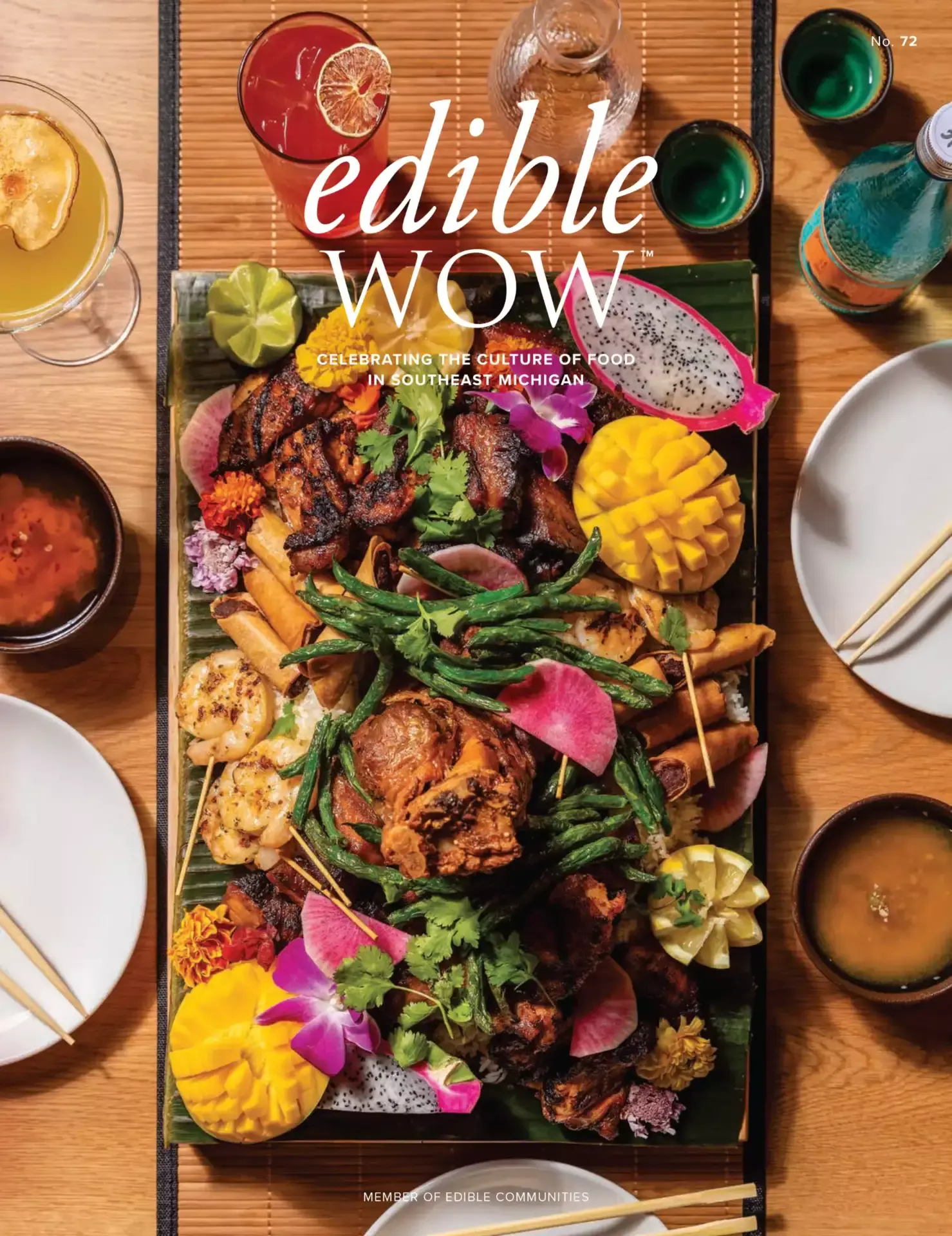
Another option, crispy pata, is a confit pork shank that Dec calls “a comfort food in the Philippines.” Dec explains that because the dish typically “doesn’t look pretty,” he and his team had a butcher cut the shank flat on the bottom to stand up vertically. It’s the star of Sunda’s Kamayan Feast for four with lumpia, pork belly adobo, garlic shrimp and chicken inasal, a communal meal that, by definition, is meant to be eaten by hand. Dec wants to evoke the experience of feasting over banana leaves by the water in the Philippines.
For dessert, Morales recommends the Sunda Sundae, a take on Filipino halo-halo (which translates to mix-mix in Tagalog) with shaved ice, ube milk and ice cream: “That’s the Philippines in a cup, basically, in a bowl.”
Sunda Detroit’s first year coincides with the PBS premiere of Dec’s documentary, “Food Roots.”
“I forever lived a life where I felt like I had to build this character, build these walls,” he explains. “Food Roots” marks a change.
Dec’s lola, his grandmother who helped raise him, imparted Filipino cuisine to Dec, but she didn’t write down her recipes before she passed. Dec had visited the Philippines all his life, and additional family loss called him back to the country of 7,641 islands. In “Food Roots,” he is a man determined to capture his culinary heritage with help from one last living elder. Lumpia is again a connector. Dec’s great-aunt, Lola Pilar, who was raised by another family, prepares lumpia sariwa, a fresh version with a wrapper akin to a crepe filled with meat and julienned vegetables, rather than the fried Shanghai style Dec grew up with and now includes at Sunda. This discovery is treated with sensitivity in the film.
Dec recommends exploring through lines tied to heritage and tradition. Such journeys can clarify “personal identity” and promote comfort in one’s own skin.
“If everyone did that, we would all be talking about things that are much more colorful, diverse,” he believes, in contrast to ugliness bred by “lack of knowledge and ignorance.”
As Sunda sets the table in Motor City, “You can see this resurgence, and you can see a lot of pride in Detroit from all the people that you’re talking to, that you’re interacting with,” Morales says. “It’ll always be home to a lot of people.”